Partialism (1 God = 3 Parts)
Partialism says that the Father, Jesus, and the Holy Spirit are proper parts. This means each part is less than the complete whole, and together they constitute God. This model's parts could be unequal.
The Trinitarian doctrine also rejects partialism. This critique therefore does not attribute the belief to all who confess the Trinity. It addresses the specific claim that the Father, Jesus, and the Holy Spirit are constituent parts of one composite God.
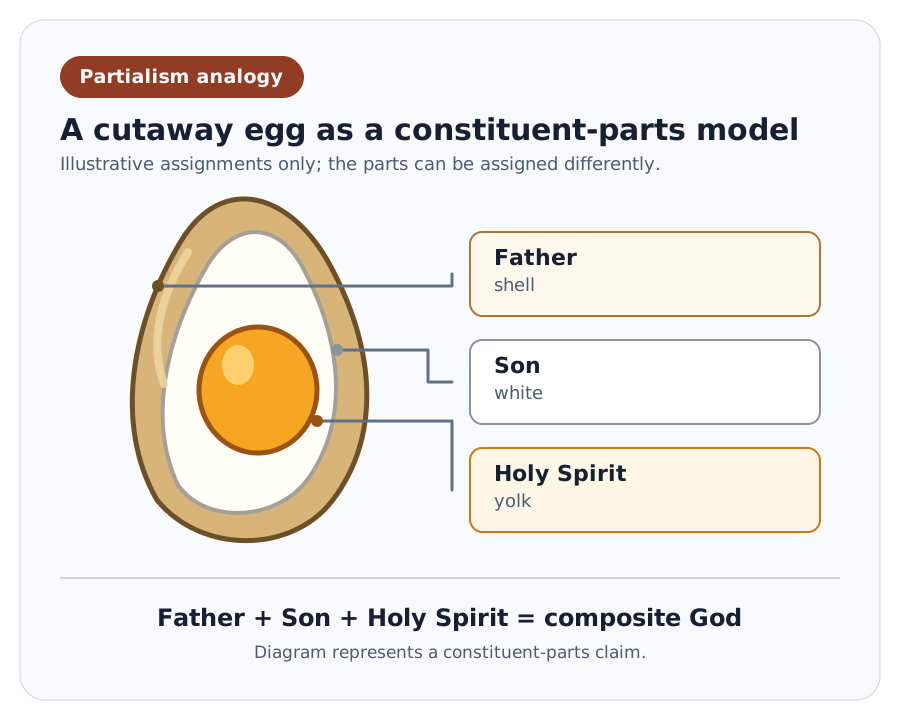
An egg's shell, white, and yolk are parts of one egg. For that reason, this common illustration depicts partialism rather than proving it. The linked author rejects the egg analogy from a Trinitarian position because it presents God as composed of parts. This article also rejects the analogy, but for reasons examined below.
The question is whether Scripture gives grounds for a composite whole above the Father, or for assigning the Father, Jesus, and the Holy Spirit to divine parts.
Biblical Identification
The first test is not whether a composite deity can be imagined. It is whether Scripture identifies God as such a whole. Israel's Scriptures first identify the LORD exclusively. The New Testament then identifies the Father and distinguishes Jesus as the one whom the Father sent.
The LORD Is One
The Shema confesses the LORD's unique identity:
“Hear, O Israel: The LORD our God, the LORD is one.” — Deuteronomy 6:4 (ESV)
Isaiah states the same exclusive identity:
“I am the LORD, and there is no other, besides me there is no God;” — Isaiah 45:5 (ESV, excerpt)
Isaiah also calls the LORD Israel's Father and Creator:
“But now, O LORD, you are our Father; we are the clay, and you are our potter; we are all the work of your hand.” — Isaiah 64:8 (ESV)
Isaiah 64:8 is not a technical Old Testament definition of a later doctrine. In context, the Father is Israel's Creator. Yet it gives no picture of a larger God assembled from separate divine persons. The LORD speaks and is addressed as the one God.
The word one alone does not settle every philosophical question about composition. Singular pronouns alone do not do so either. These texts establish the scriptural starting point:
The LORD is the one God, and Scripture does not introduce a composite divine object above him. A literal part-model therefore needs positive biblical evidence for its proposed parts.
Father and Sent Christ
Jesus addresses the Father personally in prayer:
“Father, the hour has come; glorify your Son that the Son may glorify you,” — John 17:1 (ESV, excerpt)
He then identifies the one addressed and distinguishes himself as the sent Christ:
“And this is eternal life, that they know you, the only true God, and Jesus Christ whom you have sent.” — John 17:3 (ESV)
Paul gives the same distinction:
“yet for us there is one God, the Father, from whom are all things and for whom we exist, and one Lord, Jesus Christ, through whom are all things and through whom we exist.” — 1 Corinthians 8:6 (ESV)
Paul also writes:
“one God and Father of all, who is over all and through all and in all.” — Ephesians 4:6 (ESV)
In Ephesians 4:4-6, Paul names one Spirit, one Lord, and one God and Father. This threefold list does not describe three pieces of God. It identifies the Father as the one God while distinguishing the one Lord and the one Spirit.
On this scriptural reading, the argument against literal partialism is direct:
- If the Father were a proper part of God, the whole God would exceed the Father.
- John 17:3, 1 Corinthians 8:6, and Ephesians 4:6 identify the Father himself as the one God. They do not identify a composite whole above the Father.
- If these texts are accepted as direct identifications of the Father himself as the only true God and the one God, the Father cannot be merely a proper part of a greater God.
John 17 names the personal Father whom Jesus addresses as you, the only true God, while distinguishing Jesus as the sent Christ. Paul names one God, the Father, while naming Jesus separately as one Lord. These contexts support direct identification of the Father, not an unmentioned composite above him. Grammar does not settle every metaphysical theory, but the proposed part-for-whole reading is not stated by these passages.
Therefore, literal partialism is rejected on this stated scriptural reading. The conclusion rests on Scripture's positive identification of the Father as the one God and of Jesus as the one whom the Father sent.
Human Analogy
A common literal model compares God with a human being:
“The Father is soul, Jesus is body, and the Holy Spirit is spirit.”
This analogy is an illustration, not evidence. Genesis says that the LORD God formed man from dust, breathed into him the breath of life, and man became a living creature (Genesis 2:7). Isaiah describes human seeking with both soul and spirit:
“My soul yearns for you in the night; my spirit within me earnestly seeks you.” — Isaiah 26:9 (ESV)
Matthew distinguishes body and soul (Matthew 10:28) while Paul mentions spirit, soul, and body (1 Thessalonians 5:23). The view that humans consist of three distinct elements remains disputed. Even if it were granted, it would not transfer human terms automatically to God or establish divine constituent parts.
God's Soul and Spirit
Scripture uses soul and spirit with flexibility. The LORD says of his servant:
“Behold my servant, whom I uphold, my chosen, in whom my soul delights; I have put my Spirit upon him;” — Isaiah 42:1 (ESV, excerpt)
Matthew applies this passage to Jesus (Matthew 12:18). The Father's soul expresses his delight, while his Spirit comes upon the servant. Possessive language alone does not prove that the Holy Spirit is impersonal. It does show that these labels are not fixed, exclusive names for anatomical portions of God.
Jesus says that true worshippers worship the Father in spirit and truth, and adds:
“God is spirit, and those who worship him must worship in spirit and truth.” — John 4:24 (ESV)
This worship statement does not identify the Father with the Holy Spirit or divide God into soul and spirit components. It is compatible with understanding the Holy Spirit as God's active presence and action. Scripture's flexible vocabulary prevents an automatic Father-soul, Jesus-body, and Holy Spirit-spirit mapping. It does not by itself refute every theory of composition.
Jesus' Human Inner Life
The Gospels present Jesus as a whole human subject with soul, spirit, will, sorrow, and obedience. In Gethsemane, he says:
“My soul is very sorrowful, even to death;” — Matthew 26:38 (ESV, excerpt)
John records:
“Now is my soul troubled.” — John 12:27 (ESV)
“Jesus was troubled in his spirit,” — John 13:21 (ESV, excerpt)
He prays, “not as I will, but as you will” (Matthew 26:39). These passages do not require a theory about several immaterial substances within Jesus. They do show his own human inner life.
This creates a limited objection to the simple body-only version of partialism. A claim that Jesus is merely God's bodily component fails if it denies Jesus his human soul, spirit, and will.
Mediator and Agent
Paul distinguishes God from the human mediator:
“For there is one God, and there is one mediator between God and men, the man Christ Jesus, who gave himself as a ransom for all, which is the testimony given at the proper time.” — 1 Timothy 2:5-6 (ESV)
The mediator is the man Christ Jesus, not merely divine anatomy. Peter describes the same direction of action:
“Jesus of Nazareth, a man attested to you by God with mighty works and wonders and signs that God did through him ...” — Acts 2:22 (ESV, excerpt)
God acts through Jesus. The text does not describe Jesus as a bodily part of a composite God. This supports the Father's identity as God and Jesus' identity as God's human Messiah and mediator.
Conclusion
Scripture identifies the LORD as one God, and identifies the Father as the one God while distinguishing Jesus as the Christ he sent. On that reading, the Father is not merely one part of a greater God, so literal partialism is false.
Human soul, body, and spirit do not establish divine parts. Nor is Jesus merely God's bodily component. Scripture presents Jesus as a human being with his own inner life and as the man who mediates between God and humanity.
The Bible does not describe the Father and Jesus as different parts of the same God.